
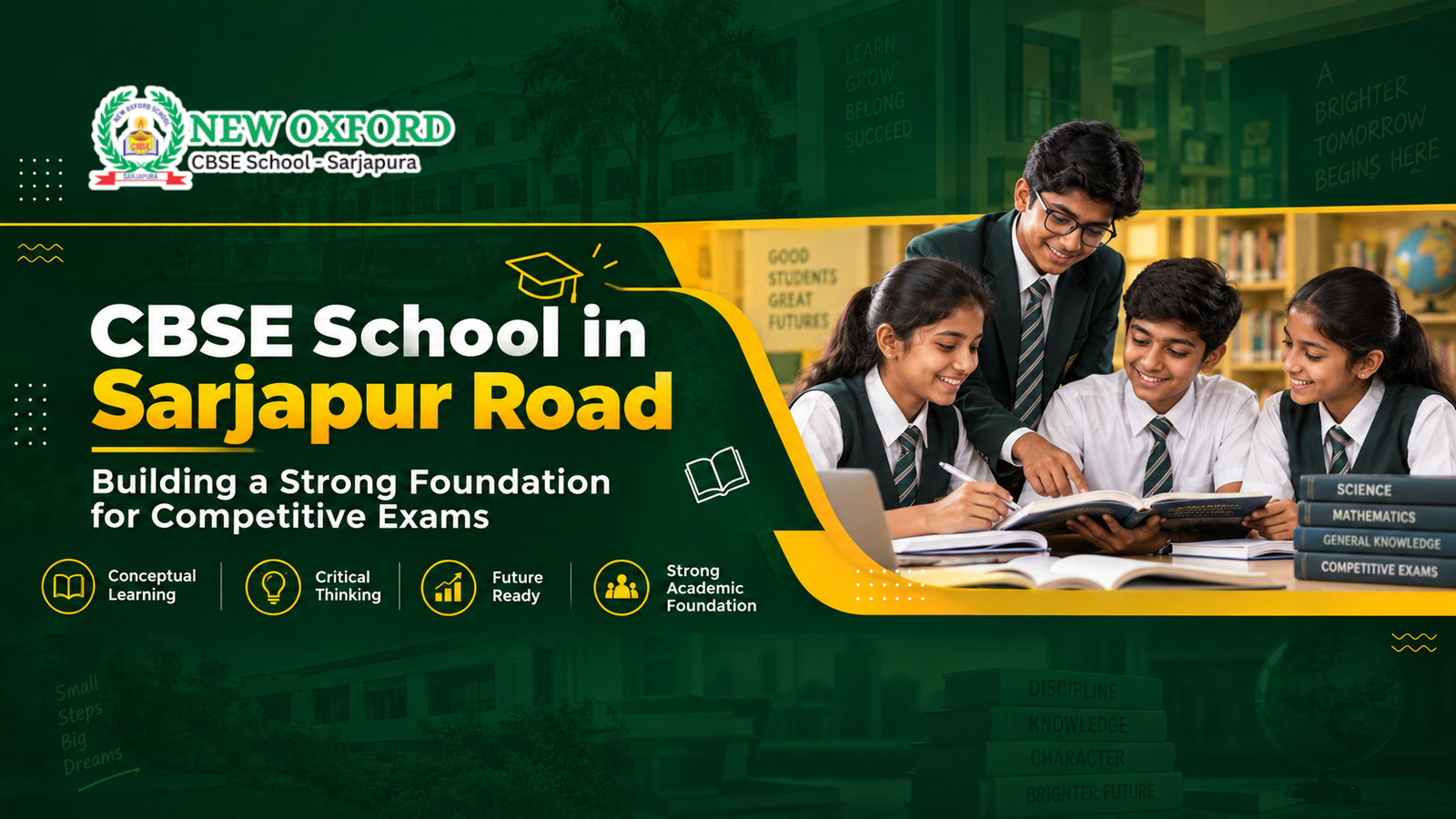
For many parents, choosing the right school is not only about helping their child score well in the next examination. It is about building strong concepts, confidence, curiosity and the ability to solve problems independently.
This becomes even more important when students eventually prepare for competitive examinations such as JEE, NEET and other national-level entrance tests.
For families searching for a CBSE school in Sarjapur Road, the curriculum and teaching methodology followed by the school can play an important role in a child’s long-term academic journey.
The CBSE approach increasingly focuses on competency-based education, conceptual understanding, application of knowledge and higher-order thinking. Rather than depending only on memorisation, students are encouraged to understand how and why concepts work.
At New Oxford School, Sarjapura , this philosophy is supported through student-centred learning, enquiry, experimentation, activity-based education and analytical teaching methods.
The objective is simple: build the right academic foundation today so that students are better prepared for the challenges of tomorrow.
Why Is CBSE Suitable for Competitive Exam Preparation?
Competitive examinations do not simply test how much information a student remembers. Students are expected to understand concepts, interpret questions, connect different ideas, manage time and apply their knowledge accurately.
This is one reason many parents consider CBSE for competitive exam preparation.
CBSE promotes competency-based learning where students learn to apply knowledge to different situations instead of treating every chapter as something that only needs to be memorised for a school examination.
These skills gradually become valuable when students move into higher classes and encounter more advanced Mathematics, Physics, Chemistry, Biology and reasoning-based questions.
A strong competitive exam foundation does not necessarily mean intensive coaching from an early age. It begins with something much simpler and more important: understanding the fundamentals properly.
1. Strong Concepts Begin in the Early Years
Competitive exam preparation should not suddenly begin when a student enters Grade 11 or Grade 12. The academic foundation develops much earlier.
Basic mathematical ideas such as fractions, percentages, ratios, measurements and patterns gradually develop into more advanced mathematical concepts.
Similarly, the curiosity students develop while exploring plants, the human body, energy, matter, motion and the environment can later support deeper learning in Biology, Physics and Chemistry.
This is why a good competitive exam foundation CBSE approach should initially focus on conceptual clarity rather than unnecessary exam pressure.
When children understand the fundamentals, advanced topics become easier to connect, analyse and learn.
2. Strong Focus on Mathematics and Science
Science and Mathematics form an important part of several national competitive examinations.
The CBSE curriculum provides structured progression in these subjects, allowing students to move from basic concepts to increasingly complex applications as they advance through different grades.
However, completing the syllabus alone is not enough. Students should be encouraged to ask questions such as:
- Why does this happen?
- Can this problem be solved in another way?
- Where would we use this concept in real life?
- What happens if one condition changes?
- How are two different concepts connected?
This type of questioning transforms learning from memorisation into genuine understanding.
Parents comparing the Best schools in Sarjapur Road Bangalore should therefore look beyond examination results and understand how Mathematics and Science are actually taught inside the classroom.
3. Competency-Based Learning Encourages Application
One of the important developments in CBSE education is the increasing focus on competency-based learning.
Students are encouraged to demonstrate what they have understood and how effectively they can apply that knowledge.
Learning can involve analytical questions, real-life problem solving, classroom discussions, experiments, projects, case-based questions, activity-based learning, collaborative activities and critical-thinking exercises.
These methods help students move beyond simply recalling answers.
Competitive examinations frequently require students to analyse a question before deciding which concept or formula should be used. Developing this habit throughout school can therefore create a much stronger academic foundation.
4. Learning Through Projects and Experiments
A child may memorise a definition for an examination and forget it several weeks later.
But when the same child performs an experiment, works on a project, observes the result and discusses why it happened, the concept can become easier to understand and remember.
This is why experiential and activity-based learning matter.
At New Oxford School, students have access to learning environments designed to encourage exploration beyond textbooks.
The school’s campus and learning facilities include dedicated Science Laboratories, a Robotics Lab, Computer Lab, Library, Activity Lab, Communication Lab and technology-supported classrooms.
These facilities provide opportunities for students to experiment, explore, collaborate and connect classroom concepts with practical learning.
For parents searching through the Top 10 CBSE schools in Sarjapur Road, the availability of facilities is important, but what matters even more is how those facilities are integrated into everyday education.
5. Problem-Solving Becomes a Habit
A strong academic student is not necessarily someone who memorises information the fastest.
A strong learner knows how to approach an unfamiliar problem.
Competitive examinations frequently present familiar concepts in unfamiliar ways. Students therefore need the confidence to analyse the information provided and work towards an appropriate solution.
A competency-oriented CBSE learning environment can help children gradually develop logical reasoning, critical thinking, pattern recognition, analytical ability, decision-making, accuracy and independent learning.
Developing these abilities takes time.
That is why CBSE for competitive exam preparation should be viewed as a gradual learning journey rather than a last-minute strategy before an entrance examination.
6. Regular Assessments Help Students Understand Their Progress
Assessment should do more than simply generate marks.
It should help teachers understand whether students have actually mastered a concept and help students identify areas that need improvement.
Class tests, worksheets, projects, practical activities, quizzes and application-oriented questions expose students to different ways of demonstrating their understanding.
Regular academic practice can also help children develop valuable habits such as carefully reading questions, managing time, checking answers, identifying mistakes, revising weak concepts and improving accuracy.
These habits become increasingly important as students move towards board examinations and competitive entrance tests.
7. Technology Can Make Learning More Interactive
Today’s students are growing up in an increasingly technology-driven environment.
When used appropriately, digital learning can help teachers explain complex concepts visually and allow students to interact with information in different ways.
New Oxford School provides technology-supported learning facilities, including digital classrooms, computer learning resources and a dedicated Robotics Lab.
Technology should not replace teachers or fundamental learning. Instead, it should help children understand difficult concepts, explore information, practise skills and develop confidence in using digital tools responsibly.
8. Competitive Success Requires More Than Academics
Preparing students for future examinations is not only about Mathematics, Science and textbooks.
Long examinations and demanding academic schedules also require concentration, discipline, confidence, time management, emotional balance, communication, persistence and the ability to handle challenges.
Sports, cultural activities, communication programmes, leadership opportunities and other co-curricular experiences can contribute to developing these qualities.
This is why parents searching for the Best schools in Sarjapur Road Bangalore should consider holistic development alongside academic performance.
At New Oxford School, academics are supported by co-curricular and extracurricular opportunities so that children can develop confidence and important skills beyond classroom subjects.
How New Oxford School Builds a Strong Academic Foundation
Every child’s academic journey is different.
Some students understand concepts immediately, while others may need additional explanation, practical examples or a different approach to learning.
A supportive school environment should recognise these differences and provide students with opportunities to learn through multiple methods.
Project-Based and Activity-Based Learning
Projects and hands-on activities encourage children to research, explore, collaborate and apply what they learn instead of simply reproducing textbook answers.
Student-Centred Learning
Students are encouraged to participate actively in the learning process, ask questions, discuss ideas and explore concepts instead of remaining passive listeners.
Practical Science Learning
Dedicated Physics, Chemistry and Biology laboratories provide opportunities for students to observe scientific principles through practical learning and experimentation.
Robotics and Technology
The Robotics Lab enables students to explore areas such as coding, technology and artificial intelligence while developing creativity, teamwork and critical-thinking skills.
Foundation Programme for Higher Grades
New Oxford School also provides a foundation course for students in Grades VI to X, designed to strengthen academic concepts and help prepare students for future competitive examinations such as IIT-JEE and NEET.
The objective during these years is not simply to train children to answer examination questions. It is to strengthen the Mathematics and Science concepts they will require when they begin advanced study.
Communication and Independent Thinking
Strong academic ability also requires students to understand instructions, communicate ideas and express their reasoning clearly.
The school’s Communication Lab supports language development through activities involving phonetics, dialogue, role play, writing and storytelling.
Together, these learning opportunities can help create the type of competitive exam foundation CBSE students need as they progress towards higher classes.
Building Competitive Exam Readiness Step by Step
Parents sometimes feel that competitive exam preparation must begin at an extremely young age.
A more balanced approach is to focus on age-appropriate academic skills at every stage.
Primary School: Build Curiosity and Strong Basics
During the primary years, children should develop strong fundamentals in language, Mathematics, Science and general awareness.
The focus should be on reading confidently, understanding basic Mathematics, developing curiosity, asking questions, observing the world around them and improving concentration.
Middle School: Strengthen Reasoning
As students progress into middle school, they can gradually develop logical thinking, scientific reasoning, independent study habits, problem-solving ability, research skills and time management.
Secondary School: Deepen Conceptual Understanding
Secondary school is the stage where students should become increasingly comfortable with complex concepts, structured revision and application-oriented questions.
The goal should not be preparing students for only one examination. It should be developing independent learners who know how to approach challenging academic situations confidently.
How Does CBSE Help Students Prepare for JEE and NEET?
JEE and NEET test students extensively in core academic subjects.
JEE focuses strongly on Mathematics, Physics and Chemistry, while NEET evaluates students in Physics, Chemistry and Biology.
A CBSE education provides students with a structured academic background in these subjects throughout their school years.
The growing focus on competency-based questions, conceptual understanding and application can also encourage students to develop skills useful for advanced entrance examinations.
However, choosing CBSE alone does not guarantee success in any competitive examination.
Success depends on several factors, including conceptual understanding, consistent study, practice, revision, problem-solving ability and each student’s individual preparation.
The advantage of developing a strong CBSE academic foundation is that students can enter the dedicated preparation stage with familiar concepts and established study habits.
How Should Parents Choose a CBSE School in Sarjapur Road?
Searching online for a CBSE school in Sarjapur Road, Best CBSE school in Sarjapur or the Top 10 CBSE schools in Sarjapur Road may produce a long list of options.
Rankings alone should not determine such an important decision.
Parents should understand the school’s CBSE affiliation, teaching methodology, teacher quality, student-teacher interaction, Science and Computer facilities, library resources, sports infrastructure, safety, co-curricular opportunities, communication with parents, transportation and overall campus environment.
Most importantly, parents should visit the school before making the final decision.
A campus visit gives families an opportunity to experience the environment, interact with the school team and decide whether the school’s learning approach matches their expectations for their child.
Why Consider New Oxford School, Sarjapura?
Established in 2012, New Oxford School is a CBSE-affiliated institution serving families in Sarjapura and nearby communities.
The school holds CBSE Affiliation No. 830703 and combines academic learning, technology, sports, activities and experiential education within its campus environment.
Students have access to dedicated Science Laboratories, Robotics Lab, Computer Lab, Library, Activity Lab, Communication Lab, digital classrooms and playground facilities.
New Oxford School also offers a foundation programme for Grades VI to X aimed at strengthening concepts for students who may pursue examinations such as IIT-JEE and NEET in the future.
For parents searching for a CBSE school in Sarjapur Road, these are important factors because a child’s future academic success begins with the quality of learning experienced every day.
Parents can explore the New Oxford School campus and facilities before planning a school visit.
Preparing Children for More Than One Examination
Competitive examinations may be important milestones, but education should prepare children for much more.
The future will require students who can think independently, communicate confidently, work with others, adapt to change and solve unfamiliar problems.
That is why a strong CBSE competitive exam preparation approach is not about placing young students under unnecessary pressure.
It is about gradually developing knowledge, curiosity, discipline, problem-solving ability, confidence and a genuine interest in learning.
When these qualities develop throughout a child’s school years, preparation for future academic challenges becomes a natural extension of learning rather than an entirely new journey.
Conclusion: Build the Right Foundation Today
Choosing the right curriculum and the right school can have a lasting influence on a child’s academic journey.
CBSE’s focus on conceptual understanding, competency-based education, experiential learning and application can provide students with skills that support future competitive exam preparation.
For parents comparing the Best schools in Sarjapur Road Bangalore or searching for the Top 10 CBSE schools in Sarjapur Road, the most important question should not simply be which school appears first on an online list.
Instead, ask: Where will my child learn to understand, question, explore and think independently?
At New Oxford School, Sarjapura, the focus is on creating a learning environment where academics work together with technology, practical learning, co-curricular development and student-centred education.
Because preparing children for tomorrow does not begin with a competitive examination.
It begins with building the right foundation today.